Episode Transcript
[00:00:00] Speaker A: Foreign.
[00:00:19] Speaker B: Hi everyone, it's me, Kirby.
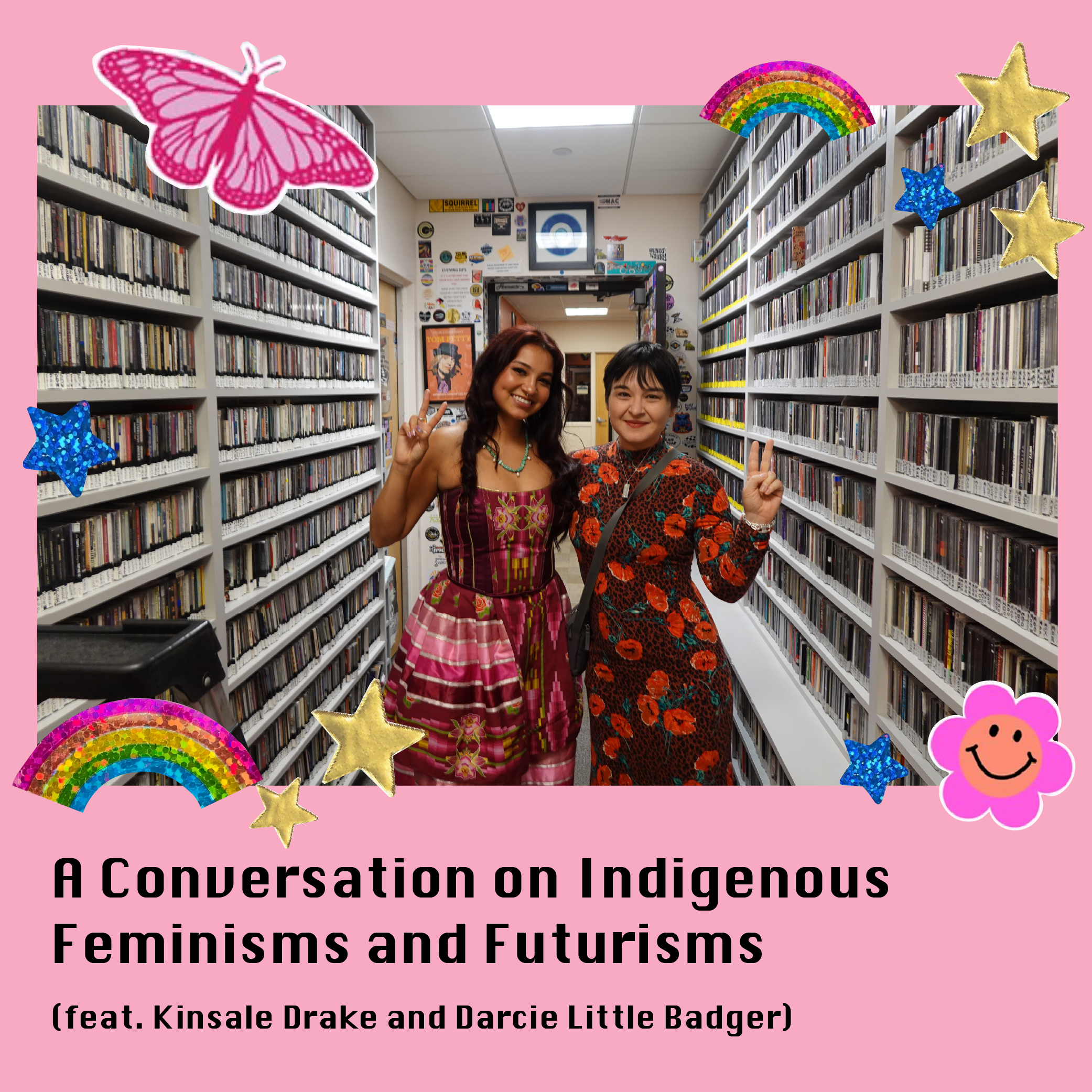
Not too long ago, I had a conversation with Kinsale Drake and Darcy Little Badger, two prominent Native writers, both powerhouses in their own right.
Last year, Kinsale and Darcy teamed up on a project with Stacey Shannon Denet Sosi, another awesome Native writer. The trio curated and assembled a book titled beyond the Glittering An Anthology of Indigenous Feminisms and Futurisms.
The anthology highlights Native voices, especially Native Women, two Spirit People, and many other underrepresented voices in literature.
The book shares its title with a story included in the collection written by Shaina A. Nez. It's a story that confronts the pervasiveness of colonization and the way Indigenous storytelling is a form of preservation and resistance.
In Nez's story, this question is posed to the reader, can we call a story forward into the future?
Every poem and story in the anthology answers a resounding yes to Shayna Nez's question.
Yes, we are carrying forward our stories of ancestral wisdom into the next world. Yes, our vibrant imaginations are nurturing the future.
What I'm saying is beyond the Glittering World is a powerful collection of writings and it's one of my favorite releases in recent years.
Since the book came out, the editors and contributors have been touring the country to promote it, which brought Kinsale and Darcy to Fort Lewis College here in Durango, Colorado.
Before their campus event, the two were gracious enough to sit down with me for a chat.
Kinsale and Darcy talk about what it was like assembling the anthology, the importance of highlighting a rich multiplicity of Indigenous voices as well as some of the pushback and controversies they've encountered while promoting the book throughout the West.
With that said, I hope you enjoy this conversation.
Darcy Little Badger and Kinsel Drake let's go and start with introductions from both of you.
[00:02:53] Speaker C: I'm Darcy Little Badger and I'm a co editor of the anthology beyond the Glittering World and I also write books and comics and I used to be an Oceanographer but in 2020 I switched to full time writing.
[00:03:17] Speaker A: Hi, my name is Kinsale Drake. I am a poet and a playwright and an editor and very happy to be one of the editors of beyond the Glittering World which was Young Readers anthology featuring poetry and prose and I'm currently based in Nashville as a teaching fellow and I'm in the MFA program at Vanderbilt. But I'm very happy to be here on my homelands too and in the Four Corners area and my family's from Navajo Mountain, Utah and I grew up in Southern California and also love coming home to Utah, so I'm happy to be in the area.
[00:03:53] Speaker B: Kinsale and Darcy, you're both listed as editors for the anthology.
I also want to mention the other indigenous writer and editor involved with it, and that's Stacy Shannon Danet. Sosi, tell me about the origins of the anthology. Like, how did you all joined forces to assemble this collection?
[00:04:12] Speaker C: Oh, that's one for Kinsale for sure. You are the one who brought us together.
[00:04:17] Speaker A: Okay. I can't even fully remember the lore, like, the deep lore, but from what I know, I knew Darcy was awesome.
I had been doing audiobooks for Darcy, so I knew her work very intimately.
But Darcy has been writing speculative fiction and indigenous kind of futurist short stories for a while. And Stacy was, like, another powerhouse Navajo writer whose work I really loved. And she writes a lot of short stories, some of them a little bit fantastical. Like, if you haven't read Missing Morningstar, there's, like, one that everyone talks about, which is when her mother comes back through the Amazon, Alexa, that's, like, in their house.
But they both kind of, to me, seem to be part of this.
A rising generation of really great fiction writers who were pushing the limits of genre, pushing the boundaries of genre.
And I knew Stacey's publisher, Toy House Press, was really interested in a project from any one of us. And so I kind of. I think it was literally just.
It was in person.
[00:05:24] Speaker C: Yeah, I remember that I was actually here for something else. And by here, I mean what state are we in? Colorado. No, it's not Colorado. It was New Mexico. Okay. All right. It was nearby. Nearby. Oh, my gosh. Sorry. I've been traveling a lot. I just came up from Texas doing book stuff.
But we sat down and Will was there, and you were there, and you kind of pitched this idea to me of an anthology of indigenous futurisms and feminisms.
And I was thinking, first of all, an anthology like that with three co editors who are indigenous, ourselves, writers, ourselves.
We're also all. They're genderqueer or women.
So that would be really cool to have that sort of representation in the, quote, the gatekeeper role, who decides what stories are going to be published.
And also, I knew your work with Indian Girls Book Club, you just have connections with so many emerging writers. These are poets. These are writers of short story fiction.
And I thought that would be a great opportunity to give them and their voices this platform to be read by a wider audience.
So I was excited to join. It was my first big experience as an editor.
So it was definitely a learning experience. But I was glad that I had you, Stacy, there to share the triumphs and the difficulties with along the way.
[00:07:00] Speaker A: Yeah, we definitely learned a lot, but that was something really important to us,
[00:07:04] Speaker C: was
[00:07:06] Speaker A: obviously, like, elders or all people from all walks of life are really important in our communities, but, like, youth in particular, bring a kind of urgency to, like, this work a lot of the times that we really need. And in Western society, quite frankly, youth are so marginalized in terms of decision making that it comes at a cost to our futures. And so that was something we really wanted to center. This notion that, I mean, emerging can mean at any age, but there are a lot of very young writers in that collection who have a kind of fire and a kind of fierce devotion behind their work that I think people just really needed to hear.
And so we talked about that in terms of book club. Right. Like, what would it be like for other young or emerging writers to encounter this anthology and to see it there altogether? Right. Like, in all of its power, not having to explain itself to any kind of Western audience and instead just existing on its own.
[00:08:00] Speaker B: You kind of touched on this a bit. But when it came to assembling the book and seeking out contributors, whose voices did you want to highlight?
[00:08:09] Speaker C: So I was kind of responsible for soliciting some of the short stories that appeared in the anthology.
And when I was looking for those, I actually did ask Kinsale and Stacey if they had any suggestions, because I didn't want to be the only person who only brought in the people that I was familiar with. I was familiar with kid lit authors, people who write young adult projects, people like AJ Eversole, people who had been in, for example, Never Whistle at Night, which is this anthology of.
Yeah, it's an anthology. I'm excited. The next one's coming out, and I can't wait to read it.
[00:08:49] Speaker A: It's even spookier.
[00:08:50] Speaker C: It is.
Each anthology will be progressively scared than the last until it's just, like, too scared to even open. Yeah, we're just gonna leave it on our shelves.
[00:08:59] Speaker A: The COVID for the. Was beautiful, but also. Yeah, like, there's some spooky stuff on that.
[00:09:04] Speaker C: It's just gonna get so scary, we
[00:09:05] Speaker A: can't even look at it.
[00:09:07] Speaker C: Just put it in a. In a. In a paper sack and be like, don't open it. But in the most. The most loving way possible.
But I'd been part of the anthology, so I knew some of the writers there.
But, yeah, I was glad for the input of Some people who I hadn't heard about, such as Tricia, who wrote our Native languages, survive us.
And her story is just.
I recommend everyone read it.
But you can tell that she really puts so much love for the importance of her language and native languages in general.
And that's because she is very involved with the reclamation kind of procedure that we have to undertake. And we had these long conversations about that and how she wanted to be respectful in her handling of this, not cross any boundaries, but also write a story that would highlight just the beauty of these languages.
So I was really pulling from a lot of different pools while I was looking for stories. And that's because I didn't want to be the type of editor who just has my friends and is just always reaching back to solicit my friends.
So, yeah, some of these writers I'd never met before.
[00:10:23] Speaker A: Yeah. And I'll just add, I think all of us collectively really wanted a focus on, like, the expensiveness of what. Or the richness, really, rather of what Indigenous means.
And so we made sure we were including Afro Indigenous voices as well, because those are often excluded from anthologies. We included a Palestinian writer who's a friend of mine, Sama, whose work actually I first encountered in direct conversation with the Navajo Nation. There was actually a.
A show when I was in undergrad about Extraction. And it was drawing similarities between Palestine and the Navajo Nation.
And I just think they all really illuminate each other really beautifully. But also importantly is, like, we all were very aware that an anthology is very limited in its scope just by nature of it having to be a physical object.
There technically has to be a limited number of people we can include. And so it really. We wanted it to be like a jumping off point. Like, it's like a sample, but it's also like a jumping off point. Like, if anybody. If you resonate with anybody, you can go down the little rabbit hole of, like, their work, and that's a really beautiful thing. But also, like, all of these people, and I think for many of us as Indigenous artists, and I think this is true for, like, pretty much everyone I've met who is bipoc and is an artist, but particularly, like Indigenous artists, is they do so much work, like, on a community level already. Like, the art is just one part of what they do. Like, the actual creative output. There's so much that goes into that. And so a lot of these folks in the anthology are also, like, doing their own really important community work. And so that shines through their work. But also it's our hope that folks will go check out what they do and hopefully find ways to support it or feel inspired by that as well.
[00:12:06] Speaker B: I'm curious to know more about the editing process. There's poetry and short stories and essays.
Did you assign each other a particular genre to focus on, or what did that look like?
[00:12:19] Speaker A: Yeah, we were, like, pretty. We were mostly split by genre, so I was mostly doing the poetry and Darcy and Stacy did mostly fiction. But there was a bit of overlap with some of those people, which is good because I think we don't really fall into those categories super neatly all the time.
Like, Shana's story had a poem at the end which is really, like, powerful.
And I feel like overall, like, the scope of the work was very. It was very wide reaching. The poetry, I think, tended to focus more on indigenous feminist understandings of the self and land. And also this theme of coming of age. Because this is a technically an anthology for young readers, we wanted young people coming of age to come to this and feel a kind of grounding or like a sense of being seen.
And so that was like. In particular, like, the poetry, the project of the poetry. And I feel like the fiction and Darcy can speak to this. I feel like the fiction was like.
It got very speculative at times, which I really appreciated because I think poetry lyrically can do so much expansive work. But, like, fiction in terms of world building does like so much for us.
[00:13:32] Speaker C: Yeah. And it was.
Sometimes I wonder if part of it was me coming from this very, like, spec fic background that a lot of the people I reached out to like. One of them, Monique Will, Black Goose, actually just won the Hugo, which is pretty big in the sci fi world. So I wanted to really see their take on indigenous futurisms, this genre that I've been working in, but that I'm exploring. Because when I first started writing, I didn't even know what this term was. And then people started saying, wow, your works are really indigenous futurism. And I was like, oh, let me. Let me Google this. And when I read some of the themes, especially this acknowledgment of the continuity of time, the way the past affects our present and our future, I just thought that was so cool because we really are a product of everything we are in this web, inextricable from those who came before us, and we impact those who will come after us.
And being an editor for these stories, it made me really appreciate my own editor because it's a lot more difficult than I'd anticipated.
Essentially, you want to do your best to help the author polish their work and bring forth a story that they are happy with, that really conveys the messages that they wanted in writing this.
Not to overstep, but also not to shy away when perhaps some feedback would help them better convey their vision.
So I was working this fine line with them, but very fortunate in that the authors themselves were receptive to criticism. And we had conversations. It was a back and forth process that sometimes we would talk over zoom, other times we would email whatever worked best with them.
And I don't know if that's something that I would have experienced if I've been working on a different anthology with different people, because since then I've talked to some other editors and there are some horror stories out there where people just don't mesh and there's clashing visions and all sorts of things. And I was like, oh, thank goodness we didn't have to deal with any of that.
[00:15:50] Speaker A: You, me and Stacy were like the most chill, supportive group ever.
[00:15:56] Speaker C: That's true. We, we tried really hard. We. We didn't want anyone to feel bad about, about their stories or their poems.
[00:16:03] Speaker A: And also because, like, working with non native editors or publishers or just non native people in general, there is a lot of, like, trauma from that that like, we were trying to be like, very aware of when it came to working with these, these folks. And so our approach was really like, how do we get this work to the point where, like, you are the happiest you can be with it and like, you feel like what you're trying to say is like really shining through. And so for me, it was like, not anything super overhauly, but I think my proudest editing moment was like, and I like to use this example because I love that poem, but the abecedarian broke open.
I gave the idea to the writer to reverse it. So it was a reverse Abecedarian. And that way we were moving towards how typically those start. And for people who don't know, an abecedarian is a poem that like, every line starts with a word that's in the letter of the Alphabet. So typically it goes like A, B, C, D that way. And so she flipped it and then she kind of broke it open with translingual kind of poetics. So moving between Spanish, English, and then almost like beyond that in a way.
[00:17:13] Speaker B: Were there any challenges that you all faced when working on the synthology? And if so, what did that look like?
[00:17:19] Speaker C: There were a lot of things that were kind of on the back end of it in terms of Scheduling with the publisher. Just little issues that we sometimes had to come together and do like a frantic group text message to work it out. But in general, we were able to not let these crises spill over to outside of the editor space.
And this includes our contacts with Tory House, who helped us out.
It was an interesting timeframe because essentially as soon as we got our stories in, suddenly we had just a few months to work on everything and to get all these stories and poems back.
So there were. I don't know about you, but there were some nights when I lay awake and was like, oh, I hope this works out. I hope this book sees the light of day. We've done so much work. Yeah.
[00:18:11] Speaker A: Which is. I feel like everybod, everybody, every editor has that kind of, has that kind of stress. You just want it. You want to do justice to like, the writers that you're working with. And so I feel like that was just our biggest, our biggest point, I guess, of interest is like, are we advocating for everyone properly? Like, are we making sure everybody has their paperwork figured out, like, just like on the back end of things? I feel like Darcy and I, we loved this process, but we were like, low key, let's never do this again.
[00:18:39] Speaker C: We'll let the others handle all of this business stuff and like trying to work out like fair ways to compensate people, things like that. These were all discussions that we had. And like Kinseo said, I feel like a lot of this is just because we come in bringing our own kind of traumatic experiences, being creative people and just not wanting anyone else to go through with that.
Especially, like, I work in the comic space a lot and I really feel especially, especially visual artists, they aren't compensated for their work as much as they deserve to be. And this is even by big, big publishers of comics.
And yeah, we don't go there. We want artists to be appreciated. So will I be an editor again?
I don't know. What about you?
[00:19:33] Speaker A: Interesting question. Maybe I like editing literary magazines. I think they'll. The long process of editing books. I think if I don't have help, like, I would never do it by myself. I'm glad I had you guys.
[00:19:45] Speaker C: Same. Yeah, 100%.
[00:19:48] Speaker B: Since the release of beyond the Glittering World, what has the response been? Like, how has the book been received?
[00:19:54] Speaker C: It's been from what I've seen and I tend not to go on like Goodreads and other spaces like that. But just the organic reception has been very positive to me.
I particularly like doing events like we're going to tonight, talk about the anthology and do some readings and then do a signing. Because this is where you really get to interact with the readers, the people who actually care about indigenous futurisms and feminisms who are a target audience for your work. And that has been great. And I do have to say that emphasize it is a. It is an anthology geared towards the young adult readers. That has been the one thing that I've seen some confusion on.
It's probably just a marketing issue with Goodreads. It's. It's so hard to apparently manipulate that site and that's where a lot of people get their. Their information.
But yeah, this is a young adult geared book. So sometimes we get people say, gosh, it read really like it was for teenagers.
[00:20:53] Speaker A: We were like, yeah, that's the point.
[00:20:57] Speaker B: Yeah.
[00:20:58] Speaker A: It's not. If you're looking for, like, if you're looking for theory, this is not that book. Like, this is like, this is like, reads for, like, you know, you go out and you have a nice day and you flip through, read a story or two, or like, you gift it to somebody younger in your life. And, you know, I think that they would really enjoy it. But it's for anybody of any age. But definitely not. It's definitely not a theory book. And I feel like people kind of expected, like, almost academic text, which is. Which was kind of exactly what we didn't want to do because we wanted it to be as accessible as possible, especially for younger people, because that was like the point of the scope of the collection was centering these emerging and younger people.
The other big reception thing is the censorship.
[00:21:44] Speaker C: Oh, Lord.
[00:21:45] Speaker A: Already we're not gonna get totally into that, but we have seen with this administration and the impact, especially this is specifically when we were in Utah, for example, with the House Bill. Yeah. Kirby's nodding. Yeah, yeah, yeah, yeah, yeah. We did get pushback on what they perceived to be, like, threatening critical race theory language, which I think says something about how powerful these books can be, to be honest. Like, if they're that afraid of an anthology for young readers with like a sheep with sunglasses on the front, like, I don't know what to tell them. But they were seriously threatened by it to the point where they, like the. The lead lawmakers in Utah had a conversation because Darcy, like, literally Darcy and her, like, picture with her pink. Ha.
[00:22:30] Speaker C: All over the Salt Lake Tribune, it's been a saga.
It all started with House Bill 261. No, we were going to do an event to talk about beyond the glittering world at Weber State University, this public university in Utah. And it was an important event because there's a big Native population there. There's people who really need to hear about these stories and perhaps could be bettered by them.
[00:23:00] Speaker A: And Stacy's also. Stacey's also from that area, and my family's from Southern Utah. So, like, Stacey in particular works with students who have to navigate these administrations and, like, in particular, these hospitals.
And it can be, like, job threatening, you know, and for the students, it can be life threatening, Right?
[00:23:16] Speaker B: Yeah.
[00:23:17] Speaker A: Their mental health is at stake in a lot of these spaces.
[00:23:20] Speaker C: Yeah. And they're taking away community centers for LGBTQ students, for Native students.
But we essentially got the speaker information request, and it gave us a long list of prohibited terms and concepts that literally included things like oppression, intersectionality, bias.
It goes on. It's quite long. Diversity.
And so all of us were not going to censor ourselves.
So Stacy and Kinsale went ahead and did the event and spoke freely, did not avoid these subjects. And I kind of published this list online, said I wasn't going to censor myself. And from there, it kicked off this chain of news stories, starting with the Salt Lake City Tribune, where they were talking about this author backed out of an event because of censorship. And actually, just a couple days ago, it turns out that the legislature responded and they were like, oh, the schools were overreaching, but we are going to change the law because we shouldn't be censoring speakers. And it kind of just shows how, like Kinsale says, how threatened they are by our voices, but also how it's important not to be afraid to challenge these laws, these attempts to silence us, to erase us in however way you can, whether it's going out there and speaking unfiltered, just speaking to that power, or whether it's calling these things out, not letting them be hidden, because this had been going on for a long time. That list had not been published before.
So by putting it out there in social media, suddenly you can't do this behind the curtains. They can't censor speakers in this sneaky way where they just stick it into the information request form.
And who knows how many people were actually too afraid by this list to have free and open communication with these students who are there to learn and who are there to develop empathy and also to see themselves play a role in the future, which is what Indigenous futurisms I love about it. We are not Native people, are not relegated to the past. We are thriving in the present, and we're going to continue be here in the future, no matter how threatening that may seem. I should say I did not say this earlier. I'm live on Apache, so my homeland is actually on my maternal line of the Little Bridge Cloud Band. So my homeland is Texas, and we have our own dealings with these anti DEI laws also going on. So I can kind of came in with this experience.
[00:26:15] Speaker B: I think it's a good transition to this last question I had.
When we write or create, we're creating toward a future.
And for me, as a essayist and poet, I see myself as writing toward an Indigenous future. I anticipate an Indigenous future, and I want my writing to plant a seed for that. And since I'm writing in a voice that's not just my voice, but also the voice of my ancestors, I'm writing to a future that carries forward my ancestors.
So with all that said, I'm just wondering, by putting this collection of stories out into the world, what do you hope to call forward?
[00:26:53] Speaker C: Yeah, I really believe in the power of stories to convey knowledge, but also to impact people at this core level that eventually influences their behavior.
And for me, I'm mostly thinking about young Native readers who are currently in this present time, probably experiencing a lot of existential uncertainty, a lot of fear about their safety, about the safety of their loved ones.
And I wanted this anthology to show them that we are fighting for them for the best possible version of the future that we. That we can. That they have importance, that they are loved. They have a place in this world that they cannot be erased. And their voices are so important.
And so I hope that they take this away. I hope they are inspired to write their own poems, their own stories, to be loud and not to be ashamed of themselves.
[00:27:56] Speaker A: Yeah, I'm on very much the same page. I usually say this at, like, every event we do. And I love that this anthology is like.
It's an anthology. It's like a portal, right? But really, the spaces we can be in physically having these conversations are the best part to me about this anthology, because we need those spaces right now.
But for me, when I'm working with youth, I think something that's really important to me, it's always like, you know, mental health is really important because I think all of us by the project of assimilation are made to feel like we are wrong. We feel wrong in our bodies simply by being alive. And we are told from the moment that we are born by, you know, settler structures and narratives that we're backwards, we're wrong. Right. And the only way to kind of reconcile with that is almost to extinguish, like, the self and literally extinguish the self and in some cases for our young people.
And the antidote to that is to reassure each other that, you know, we have always been here. We have, like a lot of great thinkers have been saying recently, we have survived the end of the world, Literally the end of the world for us, for all of our communities, and we have each other. Right. This anthology is like just a stepping stone or a. It is a portal into seeing how much stronger we can. Can be when we come together.
And also, we have the power to build the futures that we want to bring to fruition. And art, poetry, song, story, those things are both ancient and alive right now. And those are our superpowers. Right. Like, who's gonna. Who's gonna build those kinds of futures if not us? Nobody. Right. And so just know, I think letting youth and people in general know that there are people who are doing that work, who are dedicated to that work, who give their lives for that work.
It's just something I want people to carry forward. And then hopefully that. That helps them feel that there is and there will always be a place for them in. In this world and in every world. Right. I think that's why it's beyond the glittering world expansively. Right. Thinking in terms of spatiotemporality, in every sense of the word, there is a space for you and to know that and to truly, like, feel that truly in your body is something that I hope that our readers can carry forward.
[00:30:31] Speaker B: Before we wrap this up, are there any projects you're working on that you want to mention?
[00:30:35] Speaker C: Yeah, I have two books coming out this fall.
One of them is called the Sinking House, and it's part of the cabin 23 middle grade horror series. So that involves some ocean horror. And I'm very excited.
Soon I'm going to do a cover reveal. So if you're listening to this, after March, the COVID reveal has happened.
It's for children of owl, which is a book I've been working on. Yeah. Since 2019. And it's really the book of my heart. And it contains 25 illustrated pages by Abigail Rajanov.
That show really comics. So I got to put my two passions writing books and writing comics, into one, into one story of cousins who live in South Texas in a trailer park in the desert, who essentially see OWL and try to defy the bad fate that is coming. And so the question is, can they do it?
[00:31:33] Speaker A: I'm so excited. We're still trying to figure out if I'm allowed to do the audiobook or not.
[00:31:38] Speaker B: Papa.
[00:31:38] Speaker A: Papa.
[00:31:39] Speaker C: Look, I totally understand if you don't.
[00:31:41] Speaker B: Kirby.
[00:31:41] Speaker A: Yeah, Kirby. Should I do it or should I not?
[00:31:43] Speaker C: This is all on you, Kirby.
[00:31:44] Speaker A: Yeah, it's on you, Kirby.
[00:31:46] Speaker B: Thumbs up to that.
[00:31:47] Speaker C: Dang.
[00:31:47] Speaker B: Okay.
[00:31:47] Speaker A: I'm telling my mom. Kirby said yes.
[00:31:50] Speaker C: Oh, gosh.
[00:31:52] Speaker A: Oh, my gosh.
[00:31:53] Speaker C: Okay.
[00:31:53] Speaker A: Well, I just turned in my second manuscript to my editor, slash, people who are looking at it right now. I'm so excited.
It's poetry, and it is about what Joy Harjo. It explores what Joy Harjo calls and a lot of other thinkers have called enemy language.
How we understand enemy language as a tool of the state, but also how it can infiltrate and live in our bodies.
But I am a history nerd. I love.
I love history. And history is something that this country just seems to be allergic to.
That that is the kind of central tension or thesis of the collection, is a country that necessitates amnesia in order to survive.
We see that so many. At so many, like, crucial points right now, like this erasure of history and of black and indigenous presence and in presence of basically every, like, marginalized body and overt violence against them. And so this manuscript is focusing on several points throughout, specifically, like, history in the Southwest. And I could geek out about. I actually could probably talk about this for, like, 30 minutes.
[00:33:11] Speaker C: Oh, my gosh.
[00:33:12] Speaker B: Yeah.
[00:33:12] Speaker A: Well, I'm doing a lot of research about the railroads. I'm doing a lot of research in the Southwest about the Harvey houses and the Harvey girls. So if you like history, look that up.
My. My grandma. My grandma Stella was a maid at one of the Harvey house hotels in Grand Canyon.
[00:33:28] Speaker C: And.
[00:33:28] Speaker A: And the Harvey girls were very famous because they were known as opening or, like, settling the West. These, like, white women who were kind of domesticating the quote, unquote, wild west. And only unmarried white women were allowed to be Harvey girls. So the manuscript is kind of looking past that and being, like, well beyond the national narrative or archive of what was happening. Where was everybody else? What was going on? Because a lot of things were happening. Like the livestock reduction act, like, you know, quite.
Which was the same tactics as the scorched earth campaigns that happened with Kit Carson and the long Walk. These are repeats of history. And when we don't learn history, when we don't remember history, we repeat it.
And so it's kind of drawing those parallels to also the present moment. And my hope is that people see that, you know, matriarchy and matriarchal understandings of connections between community, the self, non human beings and the land are vital. And we need to pursue that in order to find a kind of balance with this natural world.
That is my like, radical vision of like the future is like we remember as an antidote to dismembering those relationships.
[00:34:46] Speaker B: Yeah. Well, I'm super excited for all the things that are in the works right now from you two, Kinsel Drake and Darcy Little Badger.
Thank you so much. I have endless gratitude for. For your storytelling and lifting up indigenous voices and. And thank you for. For being here. And thank you for having this conversation with me.
[00:35:05] Speaker A: Yay.
Thank you.
I know a little bit of lipo.
[00:35:25] Speaker B: This episode is a production of the Magic Southwest. It was written and produced by me. Graphic design by Jamie Wanczyk. Special thanks to Candace Nadon and KDUR Public Radio.
Scoring music by Alex Kem.
Support comes from the Redline Arts center in Denver, Colorado.
I am Kirby Bennett. We'll see you next time for more stories from the Magic Southwest.
[00:36:06] Speaker A: Sam.