Episode Transcript
[00:00:08] Speaker A: There's a party happening at a country club in Moab.
Men with their leather loafers drink champagne.
Women in pastel dresses, and a chandelier hangs above them, spinning.
It's 1964, and the party is hosted by Charlie Steen, the multimillionaire who first discovered uranium in southeastern Utah.
For nearly 12 years, Steen's mine outside Moab fueled the Cold War, transforming the farming community into a thriving city.
This party marked the final chapter of the uranium mining boom in Moab.
We know all of this because over 60 years ago, it was printed on new newsprint with a machine like this.
This is a Kluge printer. It's about five and a half feet tall, made of steel.
A big wheel and a thick belt are spinning. The bell rings, telling anyone within earshot that it needs to be fed more paper.
Small tubes move up and down to
[00:01:24] Speaker B: create suction with its weird little octopus fingers. That's what's able to move the paper around.
[00:01:30] Speaker A: This is Maggie McGuire. She has round glasses and paint splattered on her vans.
A few years ago, she and her husband Sam saved this printing press from going to the dump.
Today, the beast lives in their tomato greenhouse. It was once one of the workhorses at the Times Independent, Moab's source of news for the past 130 years. Maggie thinks this press was bought in the 1950s.
These machines, they were made to last centuries. But the Times Independent only used this one for about 20 years. In 2023, the paper was sold to a bigger regional media conglomerate and its printing moved elsewhere with when community members were cleaning out the historic shop, they found this old press in a back room.
[00:02:24] Speaker B: And it's just wild to me because a lot of it was built to last forever and it never stopped working.
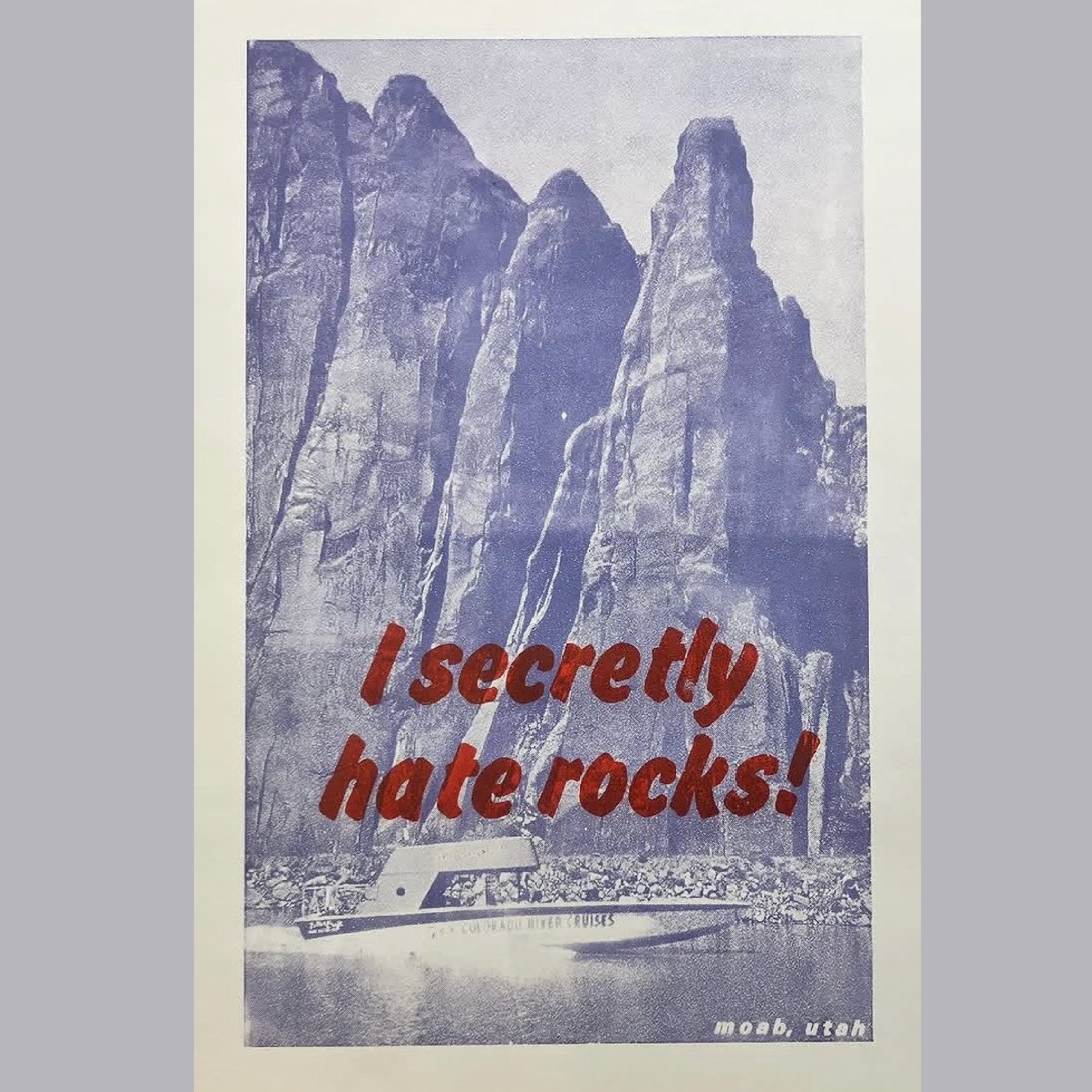
[00:02:33] Speaker A: In addition to the Kluge, Maggie and her husband also inherited thousand pound steel counters, photos, slugs and drawers filled with thousands of little wooden and metal letters. They gave this equipment a new life in their community printmaking shop. In the greenhouse, Maggie holds up a picture of a speedboat on the Colorado River. What does it say?
[00:02:57] Speaker B: It says, I secretly hate rocks. So I like it just because a lot of the stuff here in Moab is presented through like kind of this promotional lens. And this was like the, not the start of it, but like kind of the start of the PR of Moab was really like in the 60s and 70s getting out like the idea, the commercialization of Moab. And so it's fun to have images that kind of complicate that a little bit.
[00:03:24] Speaker A: At the same time the historic presses came into her life, Maggie also purchased the Moab Sun News. It's the last locally owned newspaper in Moab.
[00:03:34] Speaker B: A local newspaper is access to a platform, and we don't talk about that enough. There's all of, like, this kind of top down. Well, here we are being these cool people, and we're like, we're informing the people.
But really a real local newspaper also is saying, like, hey, do you want to try out being a reporter? Do you want to try being a photographer? Do you want to try writing a letter to the editor? Do you want to, like, experiment with media?
[00:04:02] Speaker A: Like, one time, someone emailed them a photo of a badger in the City
[00:04:07] Speaker B: Market parking lot, and all it said was, I've never seen a badger in the parking lot.
And my staff writer at the time, I was like, do you want to do something with this? And she's like, yeah.
[00:04:20] Speaker A: She ended up calling a local expert and wrote an article.
[00:04:24] Speaker B: This story about, hey, there's a badger in the parking lot actually turned into a story about our flood infrastructure, about how much that we've built over kind of some of these existing flood pathways, and that the badger usually lived in this corridor and got forced out into the parking lot. And that just linked in with huge issues here, which is that we have a really outdated flood infrastructure that's going to cost us many millions of dollars.
And there have been terrible floods in the last couple of years. So it was something that seemed like a non sequitur, right? Of like, here's a badger in a parking lot, and you could be like, well, that's not news. And in fact, it's like, visible evidence of something that we were talking about in the paper anyway.
So, yeah, when people say, hey, I'd like to see this in the paper, I believe them.
[00:05:14] Speaker A: And it's important to Maggie that the Moab Sun News is a reflection of the people who are living here in this moment in time.
It's not just the politicians and business owners who belong in the paper, but the working class and kids.
[00:05:30] Speaker B: The kid who made a ship in a bottle for a school project. You're in the EMTs that, you know, rescued a base jumper who, you know, smashed into a wall. You guys are in.
[00:05:44] Speaker A: Historically, marginalized people have been left out of the paper.
[00:05:48] Speaker B: Poor people, black people, marginalized people. And they're not in the paper. And that just means that we don't have records of them at all.
[00:05:56] Speaker A: And Maggie wants to create a record that reflects everyone, but she recognizes the challenge of being the one who decides what is newsworthy.
[00:06:05] Speaker B: I try to be aware of that, is that sometimes, you know, your judgment about what you consider newsworthy is not going to hold up to the test of time.
You know, you shouldn't be quite so confident that people in the future are going to have the same interests as you.
[00:06:23] Speaker A: Between the rise in printing costs and big media conglomerates, a print newspaper is hard to maintain and we are rapidly accelerating into a future of automation and robots.
But Maggie still believes in the importance of physical objects. Online is too ephemeral. She prefers something you can stumble across while you're at the grocery, a collection of stories and people sealed in ink.
[00:06:52] Speaker B: Having a print newspaper puts everything. It links everything together in a really permanent way that I think kind of like, I don't know, conceptually mirrors how. How I like, you know, to imagine a small town society being is. Even if you disagree, it's all. It's all connected. It's all looped together and you kind of have to take the whole thing or leave it.
[00:07:10] Speaker A: Every week, the Moab Sun News is printed on paper by human hands and machine.
The newspaper is all around town, ready for readers to pick up and hold.
This story was produced for the Transom Traveling Workshop in Moab. Special thanks to David Weinberg, Jennifer Jarrett, Kzmu Moab and Katie Ur Durango. To learn more about Transom and their workshops, you can visit transom.
[00:07:45] Speaker B: Org.