Episode Transcript
[00:00:00] Speaker A: Silverton is an old mining town in the San Juan Mountains. Its elevation is so high that there are only two weeks in the year when the ground is frost free, which means there are only two things that can grow there.
[00:00:16] Speaker B: The only thing we could have was horseradish or rhubarb.
[00:00:20] Speaker A: This is Judy Zimmerman. And for a short window in the summertime, rhubarb especially is, is all over town. It's in the cracks of the sidewalks, parking lots, and everyone's yard has a patch. Judy has lived in silverton for over 40 years, and around the time she moved there, she was at a chamber of commerce meeting.
[00:00:42] Speaker B: We were all sitting around joking about how we could keep people in town
[00:00:47] Speaker A: in the summer months. Tourists ride a coal powered train there, but they don't often stick around.
They buy their souvenirs, get back on the train and head south.
[00:00:58] Speaker B: And everybody was joking around about, well, there's strawberry festivals, there's a peach festival, there's every kind of a festival.
[00:01:05] Speaker A: And then they landed on an idea.
[00:01:07] Speaker B: So one of us said, oh, let's have rhubarb. So we started a rhubarb festival.
[00:01:12] Speaker A: It was born, the International Rhubarb Festival.
It started as a cooking competition on the 4th of July.
[00:01:20] Speaker B: Every year, everybody made something really special, would show up with just incredible food that they had made with rhubarb. Cause everybody in this town has rhubarb recipes.
[00:01:30] Speaker A: People baked pies and cakes and all the recipes they went into a cookbook. By the second year, people started experimenting.
[00:01:39] Speaker B: My husband made Budweiser beer that was so bad. Oh, but we all had different types of cocktails made with rhubarb. I have a huge collection of rhubarb alcohol recipes.
[00:01:50] Speaker A: Every year the festival grew and they even added a miscellaneous recipe category.
[00:01:56] Speaker B: One year, Travis Moore made rhubarb toothpaste.
[00:01:59] Speaker A: And by the third year, things got interesting.
[00:02:02] Speaker B: Jill Mayberry, who was with the band festival here, and a professional piccolo player, took one of the hollow stalks and she played Yankee Doodle on a stalk of rhubarb. And it was really good.
[00:02:14] Speaker A: There was also a pie eating contest in the park and games for the kids.
[00:02:19] Speaker B: We had rhubarb javelin throwing. You had to get a stalk of rhubarb and the kids points on it and see how far you could throw it. And rhubarb hats out of the giant leaves. The kids made hats out of them.
[00:02:29] Speaker A: And to prepare for the festival, people would go all in.
[00:02:34] Speaker B: There wasn't a stock of rhubarb left in this town. On the 5th of July, I even took rhubarb from the Catholic church. I mean, everything. You just went up and down the alleys. Oh, there's rhubarb in you.
[00:02:45] Speaker A: In the early 1990s, Zimmerman passed the festival off to Jackie Kerwin.
By then, you could pay $25 for a pie, and the proceeds would benefit the Silverton Public Library and Kerwin. She went kind of big with it.
[00:03:00] Speaker C: So one year we got to 300 pies that we needed, and it took us two days to cook them in the kitchen.
[00:03:09] Speaker A: Everyone all around town would offer up their fridge and oven space for the Fourth of July rhubarb pies.
And to bake all those pies, they had to scrounge up all the rhubarb they could find.
She'd even recruit community members on her missions through the alleyways.
[00:03:25] Speaker C: I would get kids to help me because, you know, kids can steal rhubarb better than adults can.
I went up and down the alleys. I mean, you know where all the rhubarb is. I would, I would. I never asked.
I have to be honest. I just took it because it was mine.
[00:03:43] Speaker A: Jackie was the rhubarb pie queen.
When I asked her if she had a favorite flavor, she explained that she invented one.
[00:03:52] Speaker C: One year we started making blue barb pies, and it was a blueberry rhubarb pie. And we actually went, had a magazine from New York come out, and they announced the blue barb pie. And it was. It was delicious. So I have to say that's probably one of my favorites.
[00:04:09] Speaker A: I first heard about this festival because of my mom.
She has a copy of the International Rhubarb Festival Cookbook. The recipes are from Jackie and Judy and everyone else in Silverton who contributed to the festival during its 40 year run. The festival intrigued me because it's pretty random that Silverton, this high elevation old mining town with only 700 people, would have an international rhubarb festival. But it also intrigued me because I grew up 30 minutes south of Silverton, and the land I grew up on, it has a number of rhubarb patches that have always been in the woods.
And it made me question, why is there so much rhubarb in the San Juans?
Where did it come from?
And what does an abandoned road in my backyard have to do with it?
[00:05:19] Speaker D: There's no wild rhubarb except in China.
So somebody brought that piece of rhubarb in.
[00:05:27] Speaker A: This is Jackie's husband, terry, during the 1860s gold rush out west miners started trespassing on Ute land in Colorado.
By the 1870s, the US government had dissolved its previous treaty with the Ute nations and signed the BRNO Agreement, which ultimately forced the Ute people off their homelands and onto reservations.
The San Juans opened up for mining and homesteading. People from all over the world fled to Silverton to strike it rich for the hard rock mining.
They brought pieces of their old worlds with them.
[00:06:12] Speaker D: Rhubarb in its dormant state can sit for six months.
So if you were living in Ohio and put a clump of rhubarb in a bucket or something and brought it out here, you could plant it and it'd grow.
[00:06:24] Speaker A: And like that, the land was colonized with foreign plants and herbs and rhubarb. Since it likes cold temperatures, it took root in the San Juans. It's everywhere, even in the most unlikely of places.
[00:06:39] Speaker D: There's one group of plants that I know of that are out in the middle of no place, but there's a mine there.
And so somebody who was mining, I assume the wife was there with them. And they, they brought something that they could grow here and make a pie out of.
[00:06:59] Speaker A: There's a small patch at the ruins of an old mine outside Silverton. Terry says it's a small plant.
[00:07:06] Speaker D: Old rhubarb is little plants. They're only 6 inches tall, which is
[00:07:10] Speaker A: one way to tell the age of a rhubarb plant. As it gets older, they receive fewer nutrients from the soil. It's a long term perennial plant.
[00:07:20] Speaker D: It lives for hundreds of years.
That's one of the reasons why people had it. You planted it and it would give you rhubarb every fall for the next hundred years.
[00:07:30] Speaker A: The pioneers knew they could plant rhubarb and it would last them the rest of their lives. Over the years, people have propagated the plants.
[00:07:40] Speaker D: And that's another thing. You know, we talk about picking the rhubarb and it's for free. Well, you can go with a shovel and just cut a chunk out of a rhubarb plant in the fall and take it home and have your own.
[00:07:50] Speaker A: So now the babies of that original rhubarb from the late 1800s are all over Silverton's alleyways. Last summer, Terry showed me some of the old rhubarb he planted nearly 30 years ago. So that's a rhubarb.
[00:08:07] Speaker D: That's a rhubarb plant.
[00:08:08] Speaker A: Across the dirt road, there was a plant with big green leaves.
[00:08:12] Speaker D: There is one that's still over There. Son of a gun.
[00:08:14] Speaker A: It was the end of July, so it was past season.
[00:08:17] Speaker D: Anyway, this is a good looking plant.
[00:08:19] Speaker A: Terry pulls up one of the stalks.
[00:08:21] Speaker D: Did you want a piece? It's in the public right away, so we can do whatever we want to this.
[00:08:26] Speaker A: Sure. Let's break off a piece.
[00:08:28] Speaker D: Yeah, I'll take a small one. Just because it's Maybe still.
You can try it. It's real sour.
[00:08:36] Speaker A: I taste it.
[00:08:37] Speaker C: Yeah.
[00:08:38] Speaker D: Don't take too much.
[00:08:39] Speaker A: Last summer, the drought wasn't very kind to the plants.
[00:08:42] Speaker D: It's also drying out.
[00:08:46] Speaker A: Yeah, it is drying out, huh? I've learned you have to get the stalks when they're pretty young or else they get woody. Like this one. I grew up near Silverton in a log cabin in an aspen grove. The land I grew up on is mostly untouched. There's no landscaping or gardens, just woods. But around our property, there are rhubarb plants.
And every June, the patches emerge from the earth like clockwork. And every summer, I use the same recipe from the International Rhubarb Festival Cookbook.
And next to this recipe, there's a story.
And it stayed with me for years. Now, this story explains that in the late 1980s, there were nearly 400 rhubarb plants in Silverton.
Of those plants, there were two varieties. A well known domestic variety, and the other variety was a mysterious variety. One night, the author was poking around people's yards and they found the biggest rhubarb plant they'd ever seen. And it was this old, mysterious variety.
They believed it was the grandfather of all the other plants in town.
It turned out that the family who owned the house in the 1800s had immigrated from northern Italy. Which means, according to this cookbook, that nearly half the rhubarb around Silverton came from Italy.
The author got to know the family of the property and they shared old letters with them dating back to the 1800s.
The letters explained the family's immigration story. From the Alps to Silverton for hard rock mining. The wife, she brought herbs with her to treat her family in the New World, including the root of rhubarb, which she planted immediately upon arriving in the San Juans.
The letters explain that their first winter in Silverton was rough. The wife was lonely. Her husband lived at the boarding house at the mine and only came to town every few weeks.
She missed her home in Italy. As winter drew on, she became depressed. The wife began to think about the rhubarb lying dormant under the snow. She knew the leaves contained a poisonous acid, which is deadly to humans. And she began to look forward to spring, when she could eat the leaves to end it all.
But when the snow began to melt, things started changing. New Italian families moved to town.
She met friends and she found community.
Her husband even found a nugget of gold in the mountains and they opened a store.
So that spring, when the rhubarb first began to peek above the snow, instead of eating the leaves, the wife made a pie with the long red stems and gave it to all her friends.
While I was in Silverton for interviews, I wanted to see if I could learn more about this woman from the cookbook, if I could track her down somehow.
[00:12:27] Speaker E: Dominica Bertram was an old Italian lady.
[00:12:32] Speaker A: This is Beverly Rich. She's another rhubarb enthusiast in Silverton. She's also a historian at the San Juan Historical Society. We are standing outside the museum in Silverton. Beverly, she grew up in Silverton and she has this memory of a woman named Dominica. She was an old Italian lady who spent her entire life in Silverton.
[00:12:56] Speaker E: And she wore a long skirt and a baboushka scarf and she spoke broken English.
[00:13:05] Speaker A: One day, Domenica was walking to the post office and passed 17 year old Beverly. She pointed to the rhubarb patches around the front porch.
[00:13:15] Speaker E: She would be walking by and she would stop and visit with me. And she'd tell me that you don't eat the leaves because they're poison on the rhubarb.
[00:13:24] Speaker A: When Beverly told me this story, I immediately thought of the cookbook story. We went inside the museum because I had questions about Dominica.
Was she the woman from the cookbook?
Bertram Beverly pulls out a big book from the shelf inside the museum.
[00:13:44] Speaker E: Bertram, John, Frank.
[00:13:47] Speaker A: It's a bunch of obituaries.
[00:13:49] Speaker E: Oh, here.
This is her. Yeah. Okay.
[00:13:52] Speaker A: It turns out that Dominica Bertram, who Beverly knew, was born in Silverton, but her mother, Dominica Ciono, had immigrated to the San Juans from northern Italy.
We look at her obituary.
Born in Estlagio, Italy, the daughter of Martin and Mary Bartoloni Fischer, Dominica came from Italy to join her father in silverton in about 1901. So she was like 20, 20 something, something. 20 something, yeah. And she. She brought the rhubarb and she planted
[00:14:27] Speaker E: it out there and probably gave it to her daughter and everybody else around.
And of course, rhubarb kind of goes wild.
[00:14:39] Speaker A: So do you think she was the original?
Do you think she planted some of the original rhubarb?
[00:14:44] Speaker E: Oh, yeah, she had to have.
[00:14:46] Speaker A: Dominica died when she was 46. It was unexpected. Her family left her at home while they took someone to the train.
And when they came back, she was dead.
I'll never know if the woman's story from the cookbook was Dominica Chiono or not. And I'm not sure how many women came to Silverton with their rhubarb from Italy during the early 1900s. But I like to imagine that it was that maybe I found her, the woman from the cookbook.
While I'm in Silverton, there's one more mystery I need to solve. When it comes to rhubarb and the San Juans. There's a rumor I grew up with that. My mom's land was once a pit stop for pioneers who were traveling over the pass to Silverton.
When my parents built our house in the early 90s, there was an old road going through a patch of cottonwoods, which they turned into our driveway. It's assumed that it was a pit stop because of the road, but also because of the rhubarb patches. During our interview, I told Beverly about this theory.
[00:15:58] Speaker E: Well, let's look at roads.
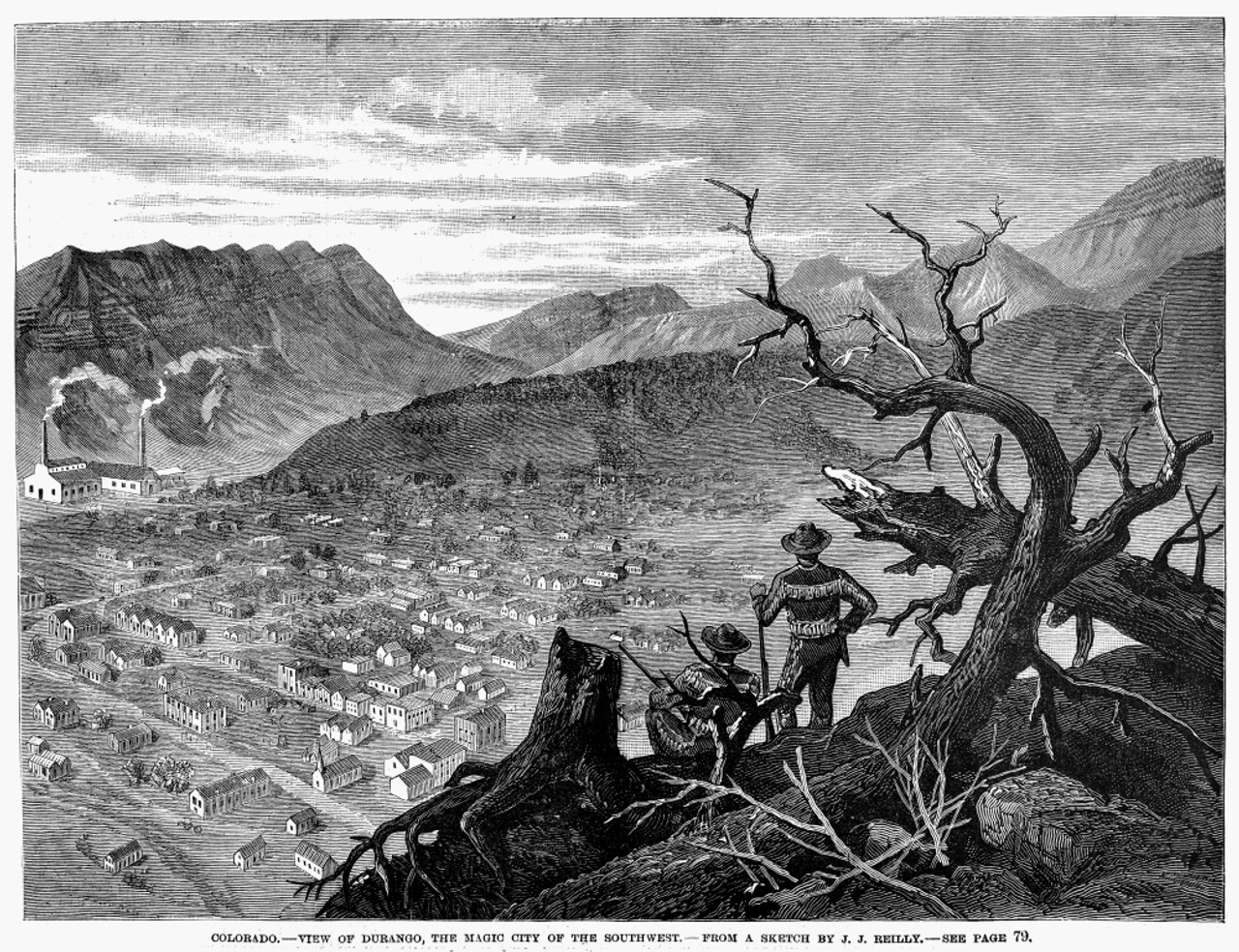
[00:16:00] Speaker A: She said. Someone once documented an old wagon road between Durango and Silverton.
Beverly lifts an old wooden box on the table.
So what are these?
In the box are a bunch of records and photos, maps and historical documents about roads in the area.
She pulls out a small piece of white paper written in 1946.
[00:16:27] Speaker E: Durango to Silverton Wagon Road. Oh, I'll bet you that's it.
[00:16:31] Speaker A: It says that in the late 1870s, prospectors began building roads from Durango to Silverton. The Rio Narrow Gauge Railroad hadn't been constructed yet, so once the San Juans opened up for mining, people from all over the world needed to get over the mountain passes into Silverton.
[00:16:50] Speaker E: The history relates, this road started from the vicinity north of Rockwood, crossed the present site of Lake Electra.
[00:16:58] Speaker A: This is where my childhood home is. If it follows the path of my driveway, it kept working its way north to the gas station.
And instead of going up to the ski resort and over Coalbank Pass, it went northeast, made a drop of about
[00:17:13] Speaker E: 2,000ft in distance of one and a half miles. Whoa, that's steep.
[00:17:20] Speaker A: When you drive between Coal bank and Mollus Pass, if you look down, you can see remnants of this old road on the hairpin turns.
[00:17:28] Speaker E: And then in 1882, the railroad was built.
[00:17:31] Speaker A: This road came before the train or the Million Dollar highway were built, which means there was a small window of time when this toll road would have been used to get over the passes into Silverton, many parts of the old
[00:17:45] Speaker E: road may still be seen.
[00:17:52] Speaker A: It's a summer day at the beginning of August. I'm at home for my mom's birthday. While dinner is cooking, we walk down from the porch to the rhubarb patch in our backyard. Okay, mom, what are we looking at?
[00:18:06] Speaker F: Right now we're looking at our largest rhubarb patch.
[00:18:09] Speaker A: This is my mom, Amy. We are kneeling in the grass. The rhubarb patch is under the aspens in the shade.
But some of the smaller ones are in direct sunlight. They've always been in the yard. My aunt and uncle and cousins used to all live next to us on the same plot of land. Their house was much older. It was built in the 1940s and was allegedly an old boarding house for outfitters and packers for a few decades. They, too, had horses and ran an outfitting business from the land.
My uncle showed my mom all the rhubarb patches around their properties.
[00:18:47] Speaker F: He told me the miners going to Silverton had planted it because this was a refreshment stop on the way before they hit the mountain passes coming from Anima City.
[00:19:05] Speaker A: So the pioneers planted these, according to Jerry.
[00:19:10] Speaker F: Right.
[00:19:12] Speaker A: The rhubarb that's all over their land is a giveaway to this theory.
But also the driveway.
[00:19:19] Speaker F: Supposedly, Jerry said it was part of a wagon road to go through the mountains to Silverton.
[00:19:27] Speaker A: I've heard this lore my whole life, but it's hard to imagine.
At the top of the driveway, there's a wall of aspen trees. So if the rumor is true and the documents at the museum are true, why does the old road just stop?
We walked over to the top of the driveway to look.
My mom looks down the driveway and spins around to look at where it stops.
[00:19:52] Speaker F: So the driveway, obviously something. It turned around here because. And they must have parked over here by the rhubarb. Right?
So they must have parked where the house is for overnight, for their little refreshment. Stop.
[00:20:07] Speaker A: We walk through the aspen grove on the land that is north of my mom's house, where the imaginary road would be.
We stop and look at the wall of aspens separating the driveway.
[00:20:20] Speaker F: If you look, see, these are all young aspen in front of us.
And those trees aren't very old. I mean, if you look at the pine tree in our yard, we planted it before you were born. Right? Before you were born. And that's about the same.
[00:20:36] Speaker A: I am 31 years old, and before I was born, my parents planted a baby pine tree in our Yard marking their new life as parents.
The one we are looking at is about the same height and width as that tree. But my mom brings up a good point. These trees weren't here over 100 years ago. They're too young.
[00:20:57] Speaker F: So those pine trees have come in since. This was a wagon road. So that's what I'm thinking. See, if you look, those are all young trees in the middle.
[00:21:09] Speaker A: We walk past the big pine through the aspen grove.
I walk over to my mom. There's a distinct parting in the aspens.
There's a fence back there.
Oh, yeah. This like, looks like a road.
[00:21:25] Speaker F: Well, come here.
[00:21:26] Speaker A: Look on river.
You can see. Okay, what can. What do you see for listeners?
[00:21:32] Speaker F: I see an aspen grove that is very thick with aspens.
And it looks like an old road cutting right through it.
That's probably, you think, about 30, 35ft.
[00:21:48] Speaker B: Yeah.
[00:21:49] Speaker F: Wonder how wide the wagon roads are. I mean, something was definitely cut. Something was definitely cut right here.
[00:21:56] Speaker A: Other than some grass and wildflowers, the ground lacks vegetation. I look down at the earth beneath my feet, like, why wouldn't the aspens grow right here?
[00:22:07] Speaker F: I don't know.
[00:22:10] Speaker A: I guess I'm curious how old this aspen grove is.
[00:22:14] Speaker F: Well, it's definitely not that old.
[00:22:15] Speaker A: It's not that old. No, I mean, this road would be over 100 years old.
For the first time in my life, I finally saw it and it finally made sense.
This was a wagon road. And that's why there's so much rhubarb on our property. Before the train and before the major highways, people from all over the world moved across this land. It was a place between their past and whatever reality awaited them on the other side of the mountain pass.
It's possible that the Italian immigrants with rhubarb stopped on this land for a night or two on their way to Silverton.
Maybe Domenica Ciono's hands planted it there under the aspens. So Jerry's theory stands up, I think.
[00:23:10] Speaker F: Yeah.
[00:23:10] Speaker A: Do you think?
[00:23:12] Speaker F: I do.
[00:23:15] Speaker A: I hadn't ever looked at this road like this before during my lifetime. We've loved this land and we've altered this land. We've planted all kinds of non native things on it that somehow survive at 8,000ft.
The lilac bush, the pine tree, the herbs, and the perennial flowers.
Like the pioneers, these plants are ultimately pieces of ourselves.
And maybe those too will stretch a hundred years into the future. It's cool to walk in there and be like, oh, yeah, time hasn't really like touched that land.
[00:23:57] Speaker F: Right.
[00:23:58] Speaker A: You know yeah, we walk through the yard. Before I walk inside, I see the pink alpine roses in the yard, which are native.
And apparently whenever there is a major disruption to the land, those roses step in to protect the ecosystem.
Like the rhubarb in the backyard every June, the roses grow along the old wagon road.
[00:24:26] Speaker D: Sam.
[00:24:52] Speaker A: This is a production of the Magic Southwest. It was edited by Kirby Bennett and reported, written and produced by me. Special thanks go to the city of Durango Creative Arts District and Redline Arts and Society in Denver, the Silverton Public Library and the San Juan Historical Museum.
Special thanks also go out to Katherine Wagner, KDUR Community Radio, my mom, Amy Rapp, and to the late Michael Goldman.
I'm Jamie Wanczak, and we'll see you soon for more stories from the Magic Southwest.